
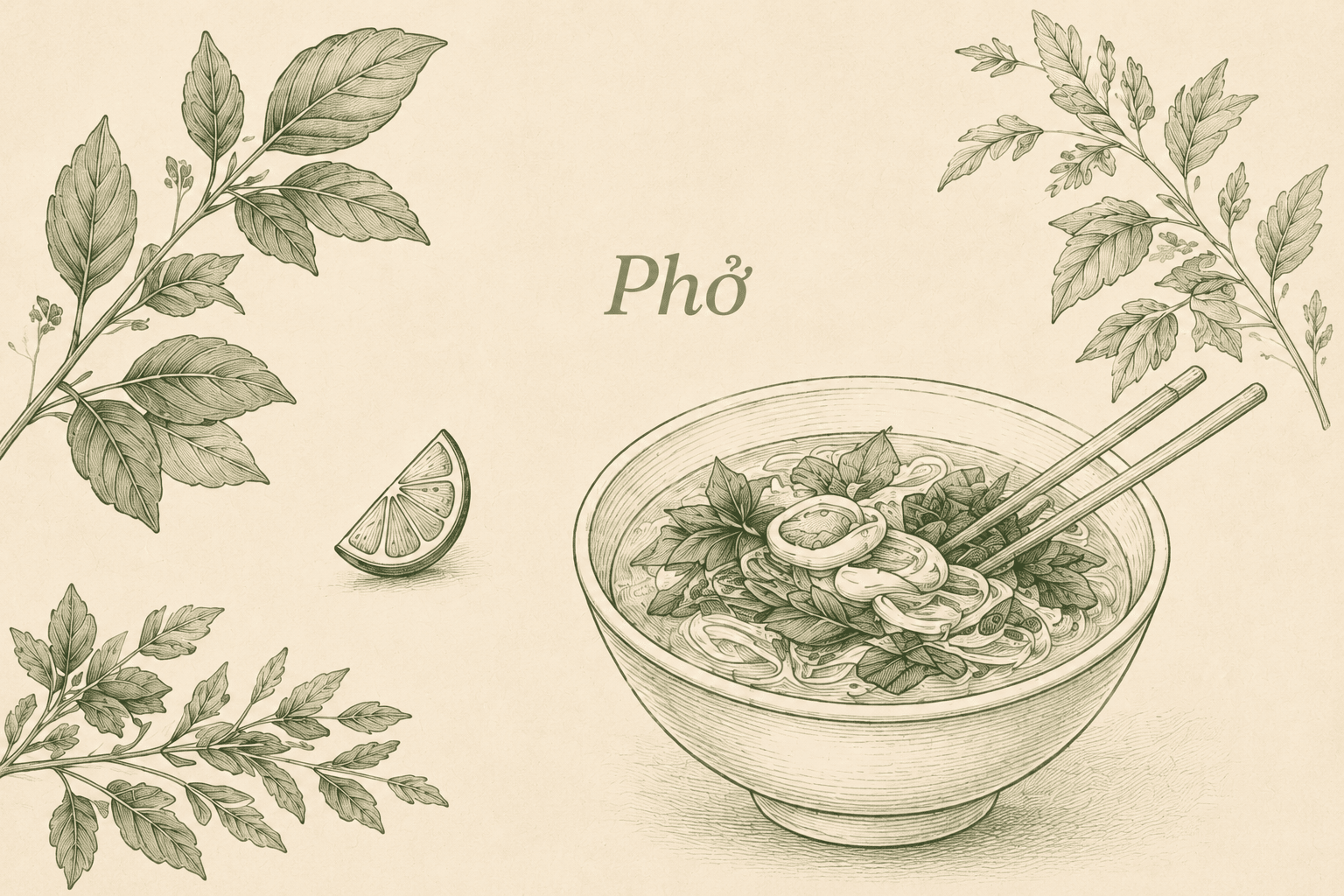
Why Phở Feels Like Home
By Tam · May 14, 2026 · 8 min read
My dad doesn't say much before nine in the morning. Most Sundays of my life, the first sound I have ever heard in our house is the low, gentle clatter of a stockpot lid being lifted, then settled again — the soft sigh of steam pushing past a half-inch gap, the smell of star anise creeping under my bedroom door before the rest of the house is awake.
By the time I come downstairs in mismatched socks, the broth has already been on the stove for hours. There is a pyramid of beef bones in the sink, freshly blanched, the water still cloudy from the rinse. The kitchen window is fogged from the inside. My dad is standing at the counter in his old gray T-shirt — the one with the small hole near the collar he refuses to throw away — slicing onions paper-thin into a bowl of cold water. He nods at me. That is the entire greeting. That is all I have ever needed.
We have been making this soup, in some version, for forty-seven years.
A short history of one bowl
My dad left Vietnam in 1979, on a small wooden boat that he describes, even now, with a kind of impatience — as though the details are not what the story is about. He spent eight months in a refugee camp in Galang, Indonesia. He arrived in the United States in 1980, alone, twenty-three, with a duffel bag and a pair of shoes that were already a size too small.
What I have learned, slowly, over years of small kitchen conversations, is that phở did not start as a recipe for him. It started as a memory. In Galang, food was rice and instant noodles and whatever the volunteers could spare, and there was a man two tents over from him who had been a phở cook in Sài Gòn. That man would describe how he used to make broth — the bones, the charred ginger, the soft, slow patience of it — and my dad listened, and remembered, and waited.
When he got to Texas, settled by a Catholic charity into a one-room apartment in Arlington, the first thing he learned to cook for himself was not phở. It was, he says with a small smile, scrambled eggs. The phở came later, in his thirties, when the longing got loud enough.
He has been refining it ever since.
Phở is the only inheritance I have from a country I left when I was small enough to be carried. My dad inherited it the long way, through hunger, through memory, through forty-seven years of standing at a stove on a Sunday morning. I inherited it the easy way: from him.
I want to be honest. I am writing this in part so that I do not forget. My dad is sixty-eight. He still makes phở every Sunday, but his shoulders are not what they were, and I have started to notice the way he leans, very slightly, on the counter while the broth simmers. So I am writing the recipe down. I am writing it down the way he makes it. Not the way the cookbooks say.
What makes a Sunday phở
If you look up a phở recipe online, you will find every possible opinion. Some people char the onion under a broiler, some over an open flame. Some toast the spices, some toss them in raw. Some swear by oxtail. Some swear by knuckle bones, brisket, neck. Some refuse to use fish sauce until the very end. Some add a knob of rock sugar; some refuse to.
My dad does not believe in any of these debates. He just makes the soup the way the man from Galang described, with small adjustments he has earned over four decades of practice. The version below is the one he made for me last Sunday. It is the version I will probably make for the rest of my life.
A few notes before you start:
- Time is the main ingredient. This is a six-hour broth. There is no way around it.
- Char the aromatics until they are almost ugly. A pale, polite char is not enough — you want the onion and ginger to be properly blistered, almost burnt.
- Skim the broth often in the first hour. That is where clarity comes from. Cloudy phở is still good phở, but a clear broth tastes like Sunday.
- Slice the raw beef while it is still partially frozen. This is the only way to get the right thinness without a deli slicer.
Ingredients
Serves 6 generous bowls.
For the broth:
- 5 lb beef bones (a mix of knuckle, marrow, and oxtail)
- 1 lb beef brisket, in one piece
- 1 large yellow onion, peeled and halved
- One 4-inch piece of fresh ginger, halved lengthwise
- 5 whole star anise
- 1 cinnamon stick (about 3 inches)
- 3 whole cloves
- 1 teaspoon coriander seeds
- 1 teaspoon fennel seeds
- 1 black cardamom pod, optional but recommended
- 2 tablespoons fish sauce, plus more to taste
- 1 ounce yellow rock sugar (about 1½ tablespoons sugar if you can't find it)
- 1 tablespoon kosher salt, plus more to taste
- 6 quarts cold water
To assemble:
- 1 lb dried flat rice noodles (bánh phở), the wider the better
- ½ lb eye of round steak, sliced paper-thin (freeze for 30 minutes first)
- A small handful of Thai basil
- A small handful of cilantro
- A small handful of sawtooth herb (ngò gai), if you can find it
- A few generous pinches of bean sprouts
- 4 green onions, thinly sliced
- ½ white onion, sliced paper-thin and rinsed in cold water
- 2 limes, cut into wedges
- A few Thai chilies, sliced
- Hoisin sauce and sriracha, on the side, for those who want them
How to make it
-
Parboil the bones. Place the bones in a large pot, cover with cold water by an inch, and bring to a hard boil for 5 minutes. Drain, rinse the bones under cool water until they are clean, and scrub the pot. This step is not optional — it is the difference between a clean broth and a muddy one.
-
Char the aromatics. Place the onion halves and ginger directly on a gas flame, or under a hot broiler, and turn them every minute or two until each side is blackened and blistered. Don't be shy. Once cooled, rinse off any loose char and trim the burnt skin from the ginger.
-
Toast the spices. In a small dry skillet over medium heat, toast the star anise, cinnamon, cloves, coriander, fennel, and cardamom for about 2 minutes — until they smell like a church on a holiday. Tie them into a small piece of muslin or a tea bag, so they can be lifted out later.
-
Build the broth. Return the cleaned bones to the pot. Add the brisket, charred onion and ginger, and the spice bundle. Cover with 6 quarts of cold water. Bring to a gentle simmer — not a boil — and immediately reduce the heat to maintain the slowest, sleepiest simmer you can.
-
Skim. For the first hour, skim the foam off the top every 10 minutes or so. After that, skim once an hour. This is meditative, mostly thankless work. Do it anyway.
-
Pull the brisket early. After 90 minutes, lift the brisket out with tongs, transfer it to a bowl of cold water for 10 minutes (to stop the cooking and tighten the meat), then drain and refrigerate until ready to serve. The bones stay in.
-
Keep simmering. Let the broth simmer for a total of 5 to 6 hours. Around hour four, lift out the spice bundle so it doesn't turn bitter.
-
Season. Strain the broth through a fine-mesh sieve into a clean pot. You should have about 4 quarts. Season with the fish sauce, rock sugar, and salt. Taste. Adjust. The broth should be deeply savory, faintly sweet, and just a little salty on its own — it will mellow once it meets the noodles.
-
Cook the noodles. Just before serving, cook the rice noodles according to the package. Drain, rinse briefly in hot water to stop them from clumping, and divide between bowls.
-
Assemble. Slice the cold brisket against the grain, as thinly as you can. Arrange a small pile of brisket and a small pile of raw eye-of-round on top of each bowl of noodles. Scatter on green onion and white onion. Bring the broth back to a rolling boil and ladle it directly over the raw beef so it cooks in the bowl — about a quart of broth per serving.
-
Serve immediately. Set out the herbs, bean sprouts, lime wedges, chilies, hoisin, and sriracha on a shared platter. Let everyone build their own bowl.
After the cooking
There is a moment, every Sunday, when my dad sits down with his bowl and does not say anything for the first three or four minutes. He just eats. The kitchen is quiet except for the small sound of his chopsticks against the porcelain and the faint, low rumble of football on the TV in the next room. The fog on the window has cleared. The morning is already half gone.
I have asked him, more than once, why he makes phở every Sunday and not, say, every other Sunday. Why he has not, in forty-seven years, ever delegated the broth to me — even though I am perfectly capable, even though I have offered.
He always says the same thing.
He says: "It is the only thing I do that takes long enough."
I think I understand what he means. Phở, the way he makes it, is a six-hour conversation with himself. It is a long, slow apology to a country that he had to leave in a hurry. It is the one place where he lets time take as long as it wants to. The broth is just the byproduct.
Make this on a Sunday, when you have nowhere to be. Skim it gently. Don't rush. Let the kitchen smell like a place someone is waiting to come home to.
That is the whole recipe.
Made by Tam · Phở & Love
Keep Reading
Read More from Phở & Love
Đọc thêm
Bánh Mì Thịt Nướng
Grilled Pork Banh Mi
View Recipe
Cà Phê Sữa Đá
Vietnamese Iced Coffee
View Recipe
Gỏi Cuốn
Fresh Spring Rolls
View Recipe